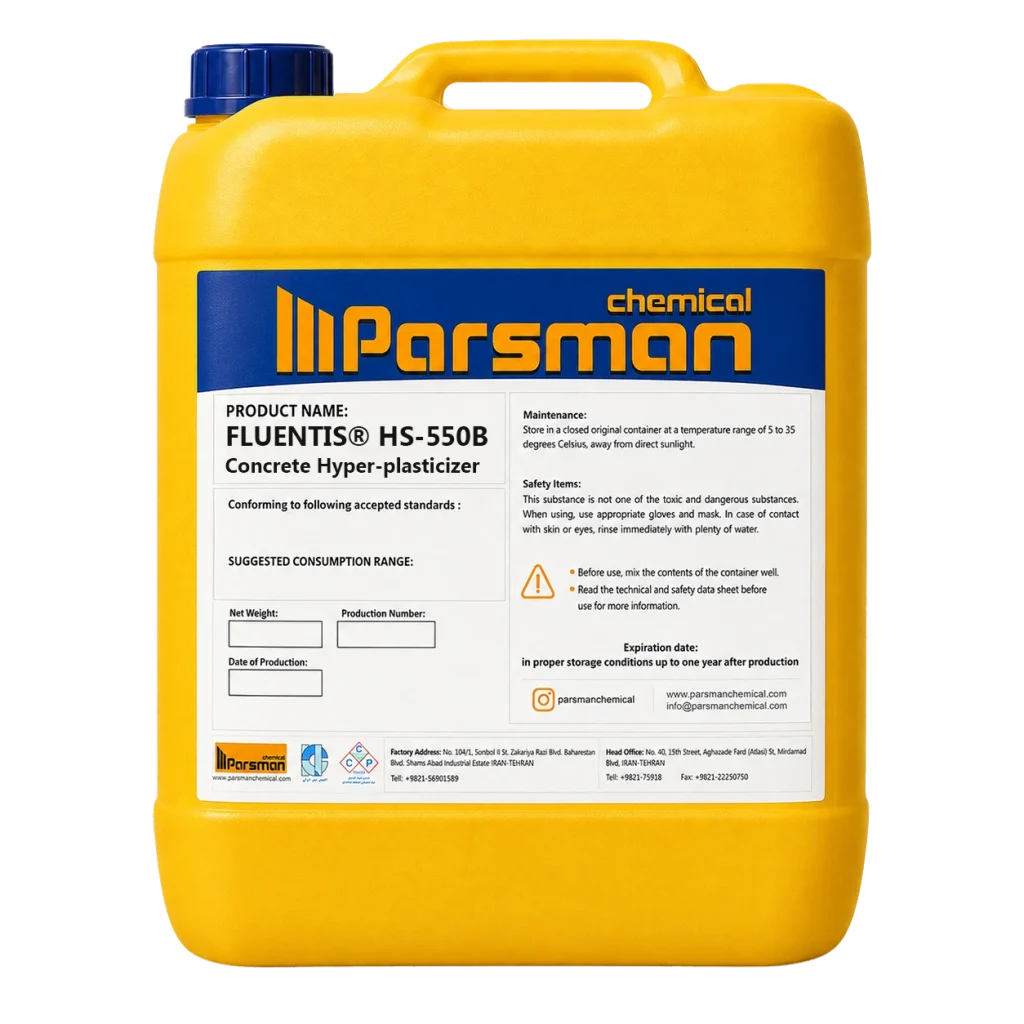
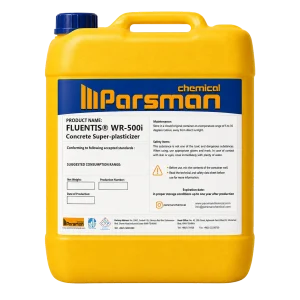
FLUENTIS HS-550B Concrete Hyperplasticizer with Very High Slump Retention
HS-550B concrete hyperplasticizer is a high-range water-reducing admixture from Parsman Chemical’s FLUENTIS® range. Based on polycarboxylate ether (PCE), it is formulated for ready-mixed concrete production in summer. It provides very high slump retention in hot weather and helps maintain workability during long-distance transport.
Water Reduction and Concrete Strength
HS-550B reduces mixing water while maintaining the same workability. With a suitable mix design, lowering the water-to-cement ratio can improve compressive strength and resistance to the ingress of water, dissolved chemicals, and carbon dioxide.
At a constant water-to-cement ratio, the admixture improves flowability and helps produce self-compacting concrete. An optimized mix design can also reduce both water and cement content while maintaining flowability. This can help reduce drying shrinkage and heat of hydration in mass concrete placements.
Benefits and Applications of HS-550B Concrete Hyperplasticizer
Significant reduction in mixing water at equivalent workability
Very high slump retention in hot weather and extended workability during long-distance transport
Suitable for ready-mixed and pumpable concrete
Suitable for self-compacting concrete (SCC), high-strength concrete, and high-performance concrete (HPC)
Suitable for mass concrete placements and the production of durable concrete
Technical Properties and Application Instructions
HS-550B is an amber, chloride-free liquid with a solids content of 40 ± 1%. The datasheet lists compatibility with reactive silica fume, the R200 set retarder, and expansive, air-entraining, and shrinkage-reducing admixtures.
The recommended dosage for typical applications is 0.10–1.0% by weight of cement. Add the admixture to the plant mixer at the same time as the mixing water. If adding it directly to a truck mixer, mix the concrete for at least 5 minutes to distribute the admixture evenly.
For best results, use water-saturated aggregates. If the aggregates are dry, premix them with part of the mixing water before the main mixing stage. Use trial mixes to determine the exact dosage based on the target slump, cement type, concrete temperature, and transport time.
Product Technical DatasheetHS-550B · PDF
فارسیThe file is not available yetEnglishThe file is not available yetالعربيةThe file is not available yetРусскийThe file is not available yetکوردیThe file is not available yet
Technical Specifications
Technical property
Value
Product name
FLUENTIS® HS-550B
Product type
Concrete hyperplasticizer and high-range water reducer
Chemical base
Polycarboxylate ether (PCE)
Physical form
Liquid
Colour
Amber
Density
1.09 ± 0.01 g/cm³
pH
3–5
Solids content
40 ± 1%
Freezing point
Approximately 0 °C
Chloride content
Chloride-free
Alkali content
Less than 1%
Recommended dosage
0.10–1.0% by weight of cement for typical applications
Recommended season
Summer
Slump retention
Very high in hot weather
Iranian National Standard
2930-2, Tables 3-1 and 3-2
ASTM standard
ASTM C494, Types F and G
European standard
EN 934-2
Parsman Chemical Concrete Hyperplasticizers | Technical Comparison and Selection Guide
Compare FLUENTIS® HW-510, HM-530, HS-550 and HS-550B for cold, transitional and hot conditions using the individual product datasheets.
Water reduction at constant slump or increased flow at a constant water-to-cement ratio
All four FLUENTIS grades are based on polycarboxylate ether. The polymer side chains help keep cement particles dispersed. This allows either a reduction in mixing water at equal workability or an increase in workability at a constant water-to-cement ratio. Define the test objective before comparing grades.
Water reduction at equal workability. With appropriate mix design and curing, reducing the water-to-cement ratio can improve strength and durability and reduce permeability.
Increased flow at constant water content. This can facilitate pumping and the production of self-compacting concrete. Check stability, segregation and bleeding separately.
Workability retention. Measure workability from batching through transport, waiting, pumping and discharge against the project limits.
Mix optimization. Validate changes to water or cement content in trial mixes. For mass concrete, assess their effect on heat of hydration and temperature within the concrete mass.
All four datasheets refer to the possibility of obtaining concrete of grade ≥ C85. Achieving this grade depends on the materials, mix design, production, curing and laboratory verification.
Grade selection by concrete temperature and transport time
HW-510 · Cold seasons and faster hardening
For ready-mixed concrete in cold seasons and projects that require faster hardening. The datasheet refers to transport for one hour or more without loss of workability in cold climates. Verify this period using the project's concrete temperature, cement and actual discharge time.
HM-530 · Transitional seasons and workability retention
Introduced for ready-mixed concrete in transitional seasons. The datasheet refers to slump retention in warm conditions and over substantial transport distances. Assess slump loss up to discharge and mix stability during pumping.
HS-550 · Summer and very hot conditions
A summer-grade hyperplasticizer with high slump retention at elevated temperatures and during long hauls. Measure slump loss over time at a concrete temperature representative of site conditions and assess setting time when selecting the dosage.
HS-550B · Summer, long hauls and specified solids content
Introduced for ready-mixed concrete in hot weather and during long hauls, with very high slump retention. The datasheet specifies an amber colour and 40 ± 1% solids. Use the effective dosage from trial batches to compare costs per cubic metre.
Common listed applications include self-compacting, pumpable, high-strength, high-performance and high-durability concrete. Mass concrete is listed for HM-530, HS-550 and HS-550B. Low-permeability concrete is explicitly listed for HW-510, HM-530 and HS-550.
Technical specifications for the four FLUENTIS grades
Property
HW-510
HM-530
HS-550
HS-550B
Chemical base
Polycarboxylate ether (PCE)
Polycarboxylate ether (PCE)
Polycarboxylate ether (PCE)
Polycarboxylate ether (PCE)
Physical form
Liquid
Liquid
Liquid
Liquid
Colour
Dark brown
Colourless to amber
Dark brown
Amber
Density (g/cm³)
1.08 ± 0.02
1.08 ± 0.02
1.09 ± 0.02
1.09 ± 0.01
pH
4–6
3–5
3–5
3–5
Solids content
Not stated
Not stated
Not stated
40 ± 1%
Freezing point
Approximately 0 °C
Approximately 0 °C
Approximately 0 °C
Approximately 0 °C
Chloride content
Nil
Nil
Nil
Nil
Alkali content
Approximately 1%
Less than 1%
Less than 1%
Less than 1%
ASTM C494 classification
Type F
Type F
Type F & G
Type F & G
The values come from the supplied datasheets. Only HS-550B has a stated solids content. Solids content alone does not establish the active polymer content or provide a basis for direct dosage conversion between grades.
Technical references listed in the datasheets
ASTM C494 Type F for HW-510 and HM-530.
ASTM C494 Type F & G for HS-550 and HS-550B.
EN 934-2 and Iranian National Standard ISIRI 2930-2, Tables 3-1 and 3-2, for all four grades.
The application notes also refer to EN 206 for consistency classes, exposure conditions and durability requirements. For project approval, check the datasheet edition, grade-specific test report and trial mix results against the contractual acceptance criteria.
Select the initial dosage using the correct units
Grade
Recommended range
Basis stated in the datasheet
HW-510
0.10–0.80%
Volume-to-weight (v/w), based on cement weight
HM-530
0.10–0.80%
Percentage by weight of cement
HS-550
0.15–1.00%
Percentage by weight of cement
HS-550B
0.10–1.00%
Percentage by weight of cement
The English HW-510 datasheet uses a volume-to-weight basis (v/w). Confirm the calculation basis and dosing equipment units before setting the dosage. For a mass-based dosage, multiply the cement mass by the dosage percentage and divide by 100 to obtain the admixture mass in kilograms. To set a pump in litres, divide the admixture mass by its density in kilograms per litre.
Trial batch comparison protocol
Record the reference mix, cement, aggregate moisture and concrete temperature. Correct the effective mixing water for aggregate moisture.
For water-reduction trials, compare dosages at the same target slump. For flow improvement trials, keep the water-to-cement ratio constant.
Measure slump or slump flow, as appropriate, from batching to the planned discharge time. Record concrete temperature, stability, setting time and strength at the ages specified by the project.
Select the dosage that meets acceptance criteria under actual transport and placement conditions. Compare the cost of the actual dose per cubic metre of concrete.
Mixing sequence, compatibility and storage
If aggregates are dry, pre-mix them with part of the mixing water as directed in the datasheets. Add the admixture to the mixer with the mixing water. The HM-530, HS-550 and HS-550B datasheets specify at least five minutes of uniform mixing when the admixture is added in a truck mixer.
Admixture compatibility
The datasheets list reactive silica fume, air-entraining admixtures, expansive agents and shrinkage-reducing admixtures. The HW-510 datasheet refers to AX100 accelerator for cold conditions. The HM-530, HS-550 and HS-550B datasheets refer to R200 retarder for very hot conditions or very long hauls. Verify dosage, addition sequence and the combined effects on setting and workability in trial mixes.
Packaging, storage and safety
The datasheets list 20-litre containers, 220-litre drums, and 1,000-litre IBC or bulk supply by arrangement. The minimum stated shelf life is one year when stored dry in the original sealed packaging at 5–35 °C. Read the safety data sheet and packaging instructions before use.
Project information for a grade recommendation and quotation
Concrete type, strength grade, target slump or slump flow, and placement method
Cement type and content, supplementary cementitious materials, and other admixtures
Concrete temperature, transport and waiting times, discharge time and setting requirements
Concrete volume, order quantity, packaging and delivery location
Prepare the project details and trial batch results for the Parsman Chemical technical team.
Why Choose Parsman Chemical Concrete Hyperplasticizers?
When choosing a concrete hyperplasticizer, consider both the required
water reduction and how long the fresh concrete needs to remain workable
before discharge and placement. Parsman Chemical’s
FLUENTIS® hyperplasticizers are based on
polycarboxylate ether (PCE) and are designed to reduce mixing water
while helping achieve the required workability. The four grades address
different temperature conditions and slump retention needs during transport.
FLUENTIS® HM-530:
A high-range water reducer for spring and autumn, with high slump
retention in warm conditions.
FLUENTIS® HS-550:
A grade for summer concrete placement, with very high slump retention
in very hot conditions.
FLUENTIS® HS-550B:
A grade for ready-mix concrete transported over long distances in hot
weather, with very high slump retention.
FLUENTIS® HW-510:
A hyperplasticizer formulated for ready-mix concrete production
during cold seasons.
To select the right grade and dosage, consider the cement type, concrete
temperature, transport time and target slump at discharge. Confirm the
admixture’s performance with a trial mix using the project materials.
For technical advice and a quotation,
contact Parsman Chemical’s technical team.