

From history to production, applications, and the effects of admixtures in modern concrete
Concrete is one of the most widely used construction materials in the world. It is produced by combining cement, water, and aggregates, and after hardening, it achieves very high strength. Concrete is essentially an artificial stone that engineers use to construct structures such as buildings, bridges, dams, tunnels, roadways, and large-scale civil engineering projects.
The popularity of concrete is attributed to its high durability, excellent compressive strength, cost-effectiveness, wide availability of raw materials, and ease of molding into various shapes. For these reasons, concrete is regarded as one of the most fundamental materials in construction across all countries worldwide.
f we want to give a very simple and easy-to-understand definition:
Concrete = water + cement + aggregates (sand and gravel)
After mixing, this combination turns into a hard and strong material.
For this reason, concrete is often referred to as an artificial (man-made) stone.
Concrete has a history spanning several thousand years and is considered one of the oldest engineering materials used by humans:
The Egyptians used mixtures of lime and gypsum in the construction of the pyramids.
The Romans produced the first true concrete by mixing lime with volcanic ash (pozzolan). Structures such as the Pantheon and the Colosseum are still standing today thanks to this type of concrete.
What is clinker?
In 1824, Joseph Aspdin invented Portland cement. This invention marked the beginning of modern concrete production and revolutionized the construction industry.
Today, through the use of concrete admixtures, superplasticizers, fibers, supplementary cementitious materials, and advanced technologies, concretes with very high strength, enhanced durability, and specialized performance are produced, such as:
These advancements have made concrete the primary structural material of the 21st century.
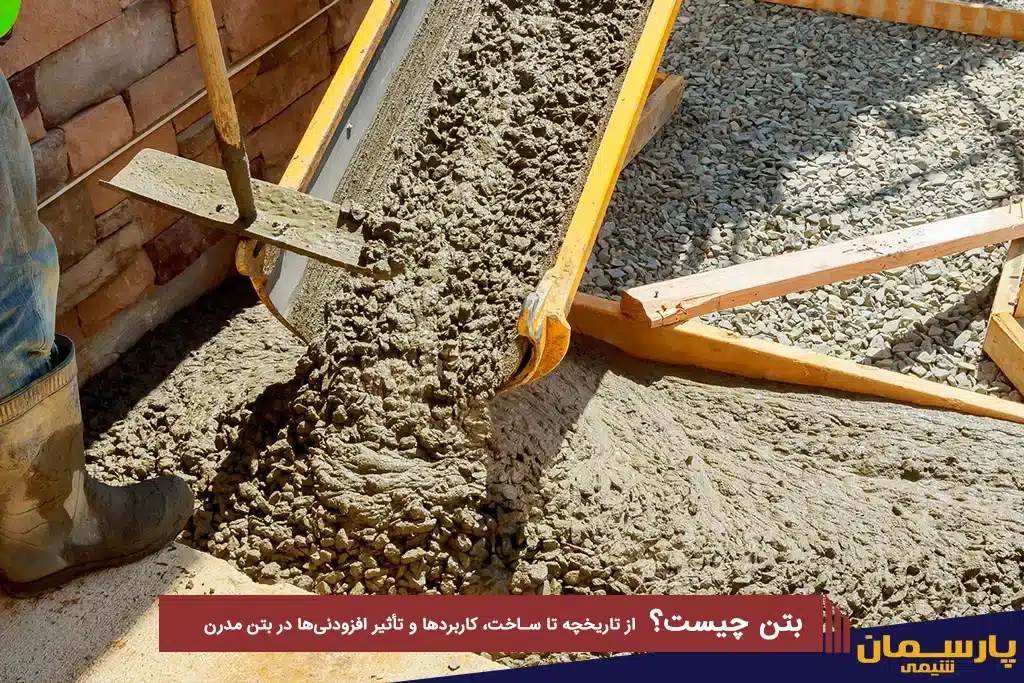
In simple terms, concrete is a mixture of paste and aggregates.
The concrete paste is formed by combining Portland (hydraulic) cement and water. This paste completely coats the surface of fine and coarse aggregates and binds them together.
After these materials are mixed, an important chemical reaction known as hydration begins. As a result of this reaction, the cement paste gradually hardens and transforms into a stone-like, highly resistant mass—this mass is what we call concrete.
Cement is the most important binding material in concrete. When mixed with water, it forms a paste that coats and binds the aggregates.
Role of cement in concrete quality:
Water initiates the hydration reaction. If its quantity is not properly controlled, the strength of concrete will significantly decrease.
Role of water in concrete quality:
Aggregates constitute 60–75% of the total volume of concrete and play the main role in load-bearing capacity.
Role of aggregates:
Accurate material proportioning and maintaining the correct balance among components are the most essential factors in producing strong and durable concrete.
The most important parameter controlling concrete strength is the water-to-cement ratio (W/C).
Reducing this ratio—without sacrificing workability—leads to:
For this reason, plasticizers and superplasticizers are used in modern concrete to maintain workability without increasing water content.
A standard concrete mix generally consists of:
| Component | Volume Percentage |
|---|---|
| Cement | 10–15% |
| Aggregates | 60–75% |
| Water | 15–20% |
| Entrapped air | 5–8% (for air-entrained concrete) |
With proper compaction and curing, this composition produces fresh concrete with high strength and durability.
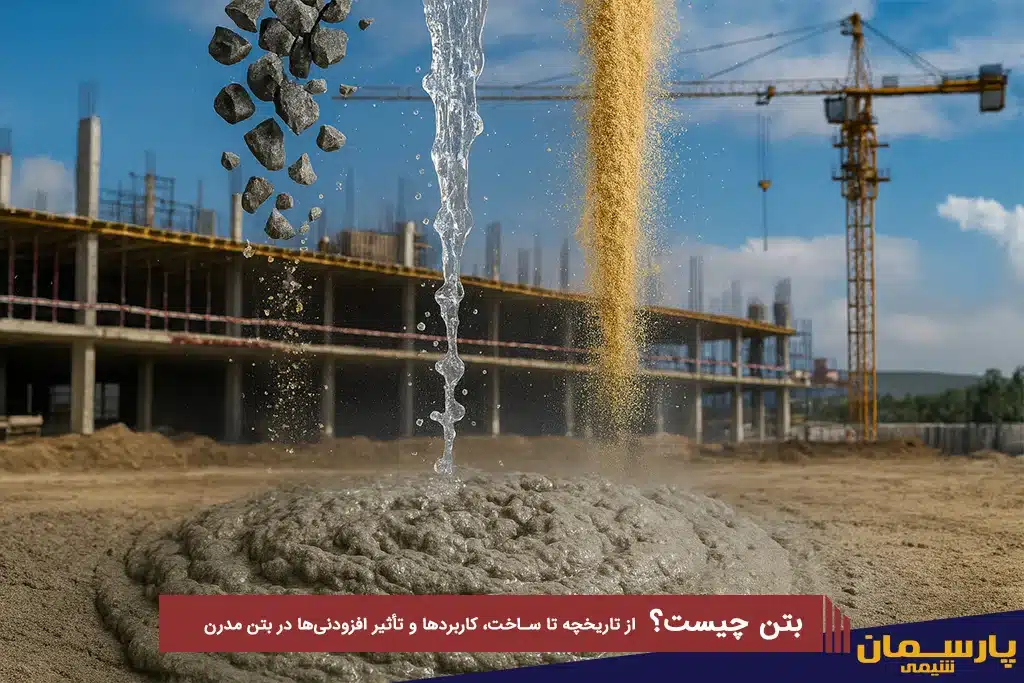
In general, any potable water with no unusual taste or odor is suitable for making concrete.
The presence of impurities, chlorides, sulfates, alkalis, or excessive suspended solids in water can:
If the quality of water is doubtful, specific laboratory tests must be carried out to evaluate its effect on concrete.
Aggregates constitute 60–75% of the total volume of concrete and play a fundamental role in its strength and structure.
Key requirements for aggregates:
Portland cement is a hydraulic material that hardens through reaction with water and acts as the binding agent in concrete.
Both the quality and quantity of cement have a significant influence on concrete strength.
After preparing the materials, the mixing stage begins.
Typical mixing sequence:
When water, cement, and aggregates are combined, a critical reaction begins.
Hydration starts immediately after mixing. During this process:
This reaction continues for years; therefore, concrete gains strength with age.
Once the concrete is fully mixed and reaches a workable condition, it must be placed into the formwork before setting begins.
Key execution considerations:
After placement and air removal:
Common finishing methods:
Curing is the most critical stage after concreting.
Why is curing essential?
Hydration requires continuous moisture to achieve adequate strength.
Curing methods include:
Important notes:
Most strength gain occurs within the first 28–30 days, but hydration continues slowly for years.
A standard concrete mix generally consists of:
The water-to-cement ratio (W/C) is the most critical factor governing concrete strength.
The lower this ratio (without loss of workability), the more:
the concrete will be.
One of the most fascinating characteristics of concrete is the change in its behavior over time. Fresh concrete, immediately after mixing, has a plastic, moldable, and highly workable consistency; therefore, it can completely fill any formwork and accurately reproduce even the smallest details. However, as time passes and the cement hydration process progresses, this plastic mixture gradually transforms into a hard, strong, and highly durable material.
This unique property—being formable in the fresh state and turning into a strong artificial stone after hardening—is the primary reason for the extensive use of concrete in the construction of skyscrapers, bridges, sidewalks, highways, dams, and all major civil engineering structures.

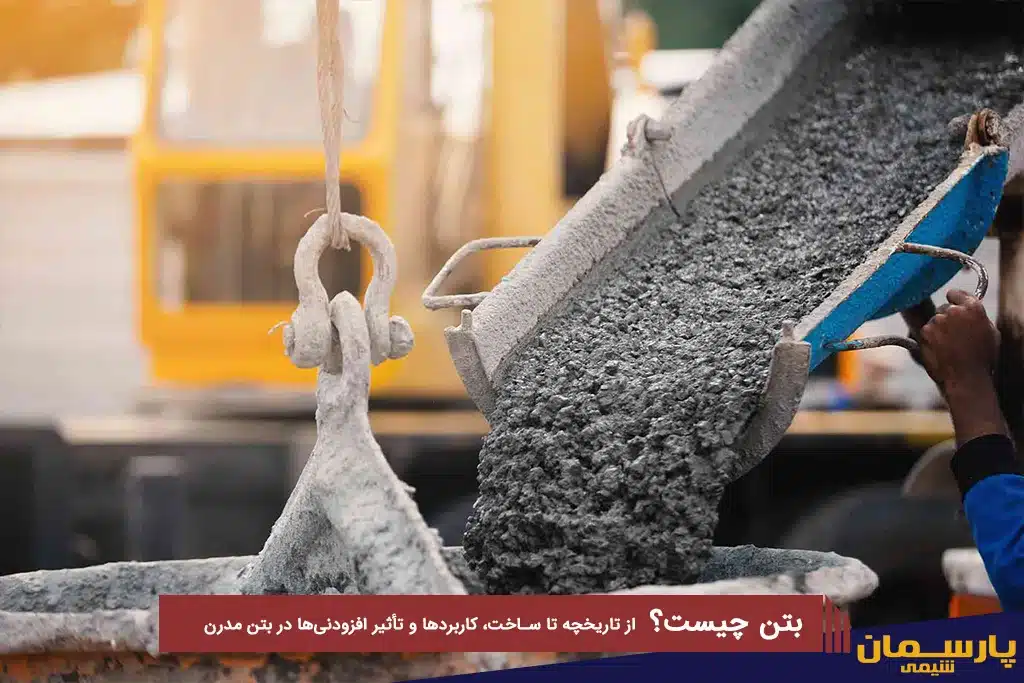
Basic concrete for general projects with moderate strength; suitable for light foundations and sidewalks.
Concrete combined with steel reinforcement to increase tensile strength; used for columns, beams, and primary structural members.
Concrete incorporating tensioned tendons or cables to span large distances; suitable for bridges and long-span structures.
Highly flowable concrete that fills formwork without vibration; ideal for heavily reinforced sections.
Contains steel or polymer fibers to reduce cracking and improve impact resistance; suitable for floors and tunnels.
Produced with lightweight aggregates such as LECA or pumice; low density and good thermal insulation; suitable for walls and lightweight blocks.
Low-cement concrete used as a blinding layer beneath foundations; prevents direct contact between soil and structural concrete.
Finished surface with visible aggregates; suitable for landscaping, sidewalks, and outdoor spaces.
Concrete applied at high velocity by spraying; used in tunnels, slopes, and repair works.
Low-water, stiff concrete compacted with rollers; suitable for dam construction and pavements.
Contains intentionally entrained air bubbles to improve freeze–thaw resistance; suitable for cold climates.
Concrete with very high compressive strength (typically above 50 MPa); used for high-rise columns and towers.
Ultra-dense concrete with fibers and special mineral admixtures; extremely strong and durable; used for special and advanced structures.
Highly flowable concrete for industrial flooring and surface correction, requiring minimal finishing.
Incorporates optical fibers; used in architectural applications and lighting design.
Produced using mineral pigments or color admixtures; suitable for pavements, landscaping, and architectural finishes.
A mixture of mineral aggregates and bitumen; used for road and street pavements.
1. High Compressive Strength
Concrete is capable of withstanding very high compressive forces; therefore, it is widely used in the construction of columns, foundations, bridges, and dams.
2. High Durability and Long Service Life
Concrete performs well under various environmental conditions such as moisture, fire exposure, temperature variations, and abrasion. With proper curing, it can maintain its performance for decades without significant deterioration.
3. Formability Before Setting
Fresh concrete has a plastic consistency and can be cast into virtually any form. This makes it highly suitable for complex architectural shapes and a wide range of structural sections.
4. Wide Availability and Cost-Effectiveness
The raw materials of concrete—cement, water, and aggregates—are widely available, and the cost of concrete production is relatively low compared to many other construction materials.
5. Compatibility with Steel and Reinforcement Capability
Concrete and steel have similar coefficients of thermal expansion, which allows them to work effectively together. As a result, reinforced concrete forms a highly stable and reliable structural system.
1. Cracking
Concrete has low tensile strength and is therefore prone to cracking if design, mixing, or curing is inadequate. To control cracking, steel reinforcement, fibers, or special admixtures are commonly used.
2. High Self-Weight
The density of concrete is approximately 2400 kg/m³, which increases the dead load of structures compared to lightweight materials. To mitigate this issue, lightweight concrete or lightweight aggregates are often employed.
3. Concrete Permeability
If the water-to-cement ratio is high or curing is improperly performed, concrete becomes porous. This allows moisture, chloride ions, and aggressive agents to penetrate the concrete, leading to reinforcement corrosion. The use of waterproofing admixtures, silica fume, and proper curing significantly reduces this problem.
4. Need for Careful Curing
To achieve the desired strength, concrete must be kept moist for several days. Insufficient curing results in reduced strength and durability.
5. Slow Early Strength Development
Compared to materials such as steel or wood, concrete requires time to set and harden. This slower early strength gain can reduce construction speed in certain projects.

Despite all the disadvantages of concrete—such as cracking, high self-weight, and permeability—many of these issues can now be effectively controlled and improved through the use of appropriate concrete admixtures. Admixtures such as superplasticizers, fibers, pozzolanic materials (e.g., silica fume), antifreeze agents, waterproofing admixtures, and air-entraining agents can significantly enhance the workability, strength, durability, and permeability of concrete, thereby improving the overall performance of the structure.
Concrete admixtures are materials that are added in small quantities to a concrete mixture to improve the properties of fresh or hardened concrete. These materials modify concrete performance during mixing, transportation, placement, or after hardening, and are essential for producing high-quality, durable concrete that meets modern standards. The use of admixtures allows better control over workability, strength, durability, permeability, and setting time, enabling concrete to perform optimally under harsh climatic or construction conditions.
As modern concrete must meet new demands—such as high-rise structures, heavily reinforced sections, aggressive environments, rapid construction schedules, and long service life—admixtures have become an integral part of contemporary concrete production. Advanced concretes such as self-compacting concrete (SCC), fiber-reinforced concrete, lightweight concrete, high-strength concrete, and many structural concretes cannot be produced without admixtures.
Concrete admixtures include various groups, each serving a specific function in modifying concrete behavior:
Concrete without admixtures generally exhibits limited strength, and increasing strength is only possible by increasing cement content or reducing water. In contrast, admixture-modified concrete—especially when using superplasticizers, silica fume, and fibers—can achieve significantly higher compressive and tensile strength without increasing cement consumption. Overall, concrete containing admixtures can demonstrate several times better mechanical performance.
Concrete without admixtures is typically more permeable and performs poorly against freeze–thaw cycles, chlorides, sulfates, and moisture. On the other hand, admixtures such as air-entraining agents, pozzolanic materials, waterproofing admixtures, and corrosion inhibitors reduce permeability and significantly extend the service life of structures. Admixture-enhanced concrete shows much higher durability in harsh and aggressive environments.
At first glance, concrete without admixtures may appear less expensive. However, difficult placement, higher cement demand, cracking, and future repair costs increase overall expenses. Concrete with admixtures may have a higher initial cost, but through reduced cement consumption, improved workability, lower damage, and extended service life, it proves to be more economical and cost-effective in the long term.