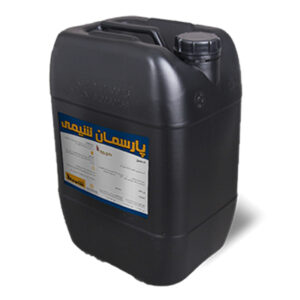
Concrete plasticizer code CLS-300 product of Parsman Chemical is a modified water reducer of the second generation of lubricants that coincidents the needs of concrete producers and consumers in all seasons. This product has the ability to maintain proper slump in hot temperature and environment conditions.
Technical specifications of concrete plasticizer code CLS-300:
Product Technical DatasheetCLS-300 · PDF
فارسیThe file is not available yetEnglishThe file is not available yetالعربيةThe file is not available yetРусскийThe file is not available yetکوردیThe file is not available yet
Technical Specifications
base material
Modified lignosulfonate
appearance
Liquid
color
Dark brown
Density
0.05 ± 1.1 g/cm3
PH
6-7
Freezing point
0 ̊ C approx
chloride
The amount of chlorine without chloride
The amount of alkalinity
The amount of alkalinity is less than 1
Recommended dosage
0.5 to 1.5 of cement weight for normal use
Standard
National Standard 2930-2, Tables 3-1 and 3-2ASTM C494 Type F&GEN 934-2
Parsman Chemical Concrete Plasticizers: Selection, Dosage and Performance Control
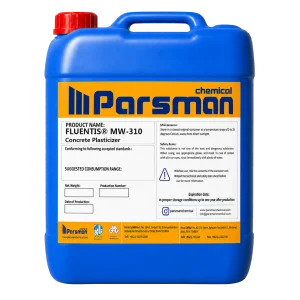
Compare concrete plasticizers FLUENTIS® MS-350, MM-330 and MW-310; select a grade for concrete temperature, transport time and workability retention
FLUENTIS Concrete Plasticizers: PCE-Based Water Reduction and Workability Retention
Concrete plasticizers FLUENTIS® MS-350, MM-330 and MW-310 from Parsman Chemical are based on polycarboxylate ether. These three grades reduce water demand at equal workability or increase flow at a fixed water-to-cement ratio, helping control fresh-concrete behaviour and improve hardened-concrete quality. Their main differences concern temperature suitability and slump retention.
Technical benefits shared by all three grades
Lower mixing-water demand at equal workability: Supports higher compressive strength and lower permeability with appropriate mix design, compaction and curing.
Greater workability at the same water-to-cement ratio: Facilitates flowing and self-compacting concrete with a suitable mix design.
Optimized cement consumption: Enables simultaneous water and cement reduction in suitable redesigned mixes while maintaining strength and durability requirements.
Supporting durability management: Helps reduce ingress of water and aggressive agents and manage shrinkage and heat of hydration in optimized mixes.
Seasonal grade selection: Different grades for cold, moderate, hot and very hot conditions, rather than one formulation for every project.
Distinguish increased flow at constant water content from water reduction at constant flow. Confirm dosage and final performance using the actual project materials.
Concrete Plasticizer Applications: Grade Selection for Actual Placing Conditions
All three datasheets list self-compacting concrete SCC, high-strength, pumpable, high-durability and high-performance concrete HPC and low-permeability concrete. For MS-350 and MM-330, mass concrete is also listed.
MS-350: summer and very hot conditions
This grade is intended for summer concrete production and offers very high slump retention in very hot conditions. Maintaining workability in hot weather is central to its selection for ready-mix concrete and projects with considerable transport distances.
MM-330: transitional seasons and moderate to hot weather
This grade is intended for transitional seasons and moderate to hot conditions, with high slump retention. For plant-produced concrete requiring flow retention during delivery, verify performance against the transport and discharge schedule.
MW-310: cold and moderate weather
This grade is designed for cold and moderate conditions, with suitable slump retention in these conditions. Its datasheet also highlights strength development in cold weather; confirm dosage and setting behaviour under actual project conditions.
An admixture does not replace mix design. Assess the relevant acceptance criteria separately for self-compacting, high-strength and other special concretes.
Technical Comparison of MS-350, MM-330 and MW-310
The following table compares the specifications declared in the three datasheets. Density or pH differences alone do not indicate water-reducing capacity or final concrete strength.
Property
MS-350
MM-330
MW-310
Base material
Polycarboxylate ether (PCE)
Appearance and colour
Dark brown liquid
Density g/cm³
1.06 ± 0.02
1.06 ± 0.02
1.05 ± 0.02
pH
4–6
3–5
4–6
Freezing point
Approximately 0 °C
Chloride
Chloride-free
Alkali content
Less than 1%
Stated temperature conditions
Very hot; summer
Moderate and hot; transitional seasons
Cold and moderate
Slump retention
Very high
High
Suitable for cold and moderate weather
Typical dosage; % by cement mass
0.3–1.5%
0.20–1.5%
0.2–1.5%
Technical Specifications versus Test Results
Slump-retention descriptions are qualitative datasheet statements and do not establish an identical duration for all three grades. Numerical water reduction, slump-retention time and compressive strength require a valid test report for the specific grade and mix design.
Standards Listed in FLUENTIS Plasticizer Datasheets
Product
ASTM reference
Shared references
MS-350
ASTM C494 Type F & G
EN 934-2 Iranian National Standard 2930-2; Tables 3-1 and 3-2
MM-330
ASTM C494 Type F
MW-310
ASTM C494 Type F
The datasheets also refer to concrete design for consistency classes, exposure conditions and durability according to EN 206. When submitting documentation to project supervision, review the grade-specific datasheet together with the test report and mix design.
Do not assume identical standard types for every grade: the datasheet for MS-350 lists Types F & G, while the other two grades list Type F.
FLUENTIS Concrete Plasticizer Dosage: Based on Cement Mass
The following ranges are declared for typical applications. Percentages refer to cement mass. Final dosage depends on cement type, materials, concrete temperature, target workability and required slump-retention time.
Model
Percentage of cement mass
Quantity for 350 kg of cement
MS-350
0.3–1.5%
1.05–5.25 kg
MM-330
0.20–1.5%
0.70–5.25 kg
MW-310
0.2–1.5%
0.70–5.25 kg
The last column calculates the declared percentage range for an assumed cement quantity; it is not a separate dosage recommendation.
Admixture dosage calculation
Admixture mass equals cement mass multiplied by dosage percentage, divided by 100. To convert kilograms to litres, divide mass by product density; the density of MW-310 differs from the other two grades.
Evaluate the selected dosage in trial mixes, then calibrate dosing equipment to the actual units used.
Use and Storage of MS-350, MM-330 and MW-310
Material preparation and addition to the mixer
All three datasheets advise against using dry aggregates without preparation. If aggregates are dry, premix them with part of the mixing water before the main mixing stage. Include this water and aggregate moisture in mix-design calculations.
Add the admixture with the water in the batching-plant mixer. When adding it to a truck mixer, provide at least 5 minutes of uniform mixing as specified in the datasheets.
Complementary admixtures for the application conditions
The datasheets for MS-350 and MM-330 identify the retarder Parsman Chemical R200 for additional setting delay in very hot weather and on exceptionally long transport routes.
The datasheet for MW-310 identifies the accelerator Parsman Chemical AX100 for faster setting and strength development in very cold weather.
Reactive microsilica, expansive, air-entraining and shrinkage-reducing admixtures are also listed as compatible materials. This does not authorize direct blending of concentrated products; confirm the addition sequence and combined dosage.
Quality control before site use
Check initial workability, slump loss over the transport period, mixture stability and, where required, setting time and strength using actual project materials. Repeat evaluation after changes in cement, grading, temperature or admixture combination.
Storage, packaging and safety
The datasheets state storage for at least one year in a dry place, in sealed original packaging, at 5–35 °C. Listed packaging includes 20-litre containers, 220-litre drums, and supply in 1,000-litre tanks or bulk tankers. Read the safety data sheet and packaging instructions before use.
Buying Parsman Chemical Concrete Plasticizers and Requesting a Quote
To choose between MS-350, MM-330 and MW-310, first establish temperature conditions and transport time, then determine the dosage needed for target workability through trial mixes. Price per kilogram alone is not an adequate economic comparison; cost per cubic metre depends on the confirmed dosage.
Information needed for technical advice and a quotation
Required model, cement type and cement content per cubic metre
Initial slump and required workability-retention period
Concrete temperature, season, transport time and placing method
Microsilica or other concurrently used admixtures
Order quantity, packaging and delivery location
MS-350: summer and very hot weather; MM-330: transitional seasons and moderate to hot weather; MW-310: cold and moderate conditions.
Why Choose Parsman Chemical Concrete Plasticizers?
Quality concrete starts with an admixture suited to the materials and
placement conditions of your project.
FLUENTIS® MS-350,
FLUENTIS® MM-330 and
FLUENTIS® MW-310
concrete plasticizers from Parsman Chemical are based on polycarboxylate
ether. By reducing mixing water and improving fresh concrete workability,
they help produce concrete with the required strength and durability.
MS-350 is designed for very hot conditions
with very high slump retention;
MM-330 is intended for moderate and hot
conditions with high slump retention; and
MW-310 is intended for cold and moderate
conditions. The appropriate grade and dosage are selected by assessing
cement type, concrete temperature, transport time and trial mix results.
For product selection, technical advice and a quotation,
contact Parsman Chemical specialists.