
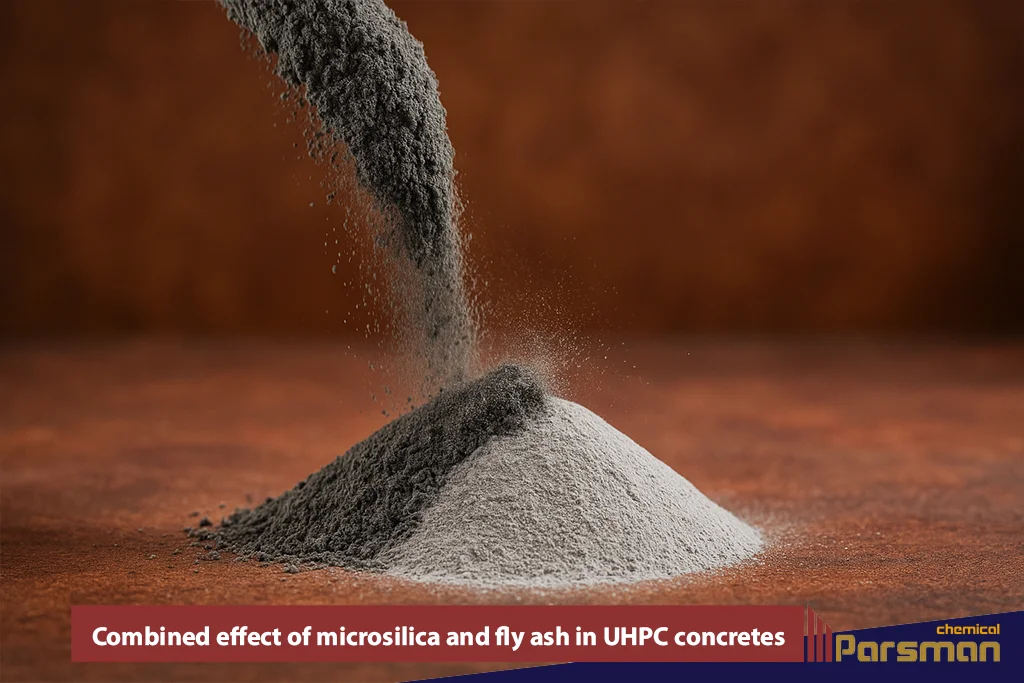
The combination of silica fume (SF) and fly ash (FA) as a partial replacement for cement in concrete is considered one of the advanced approaches in modern concrete technology. This blend creates a synergistic effect that enhances the performance of concrete in both the short and long term.
Ultra-High Performance Concrete (UHPC), due to its high density and exceptional strength, requires a precise mix design to achieve its desired properties. Among the key supplementary cementitious materials, silica fume and fly ash play a crucial role. When used together, their unique characteristics complement each other, leading to superior mechanical and durability properties of UHPC. In the following sections, a detailed analysis of this combined effect is presented.
Microsilica base products
Silica fume consists of extremely fine particles at the nanometer scale, with a specific surface area of approximately 20,000 m²/kg. These characteristics enable silica fume to rapidly participate in chemical reactions during the early days of concrete curing.
During the cement hydration process, a significant amount of calcium hydroxide (Ca(OH)₂) is produced. The presence of silica fume causes this calcium hydroxide to be consumed and transformed into calcium silicate hydrate (C-S-H) gel, which is the primary compound responsible for increasing the strength and reducing the porosity of concrete.
Main reaction equation:
SiO2+Ca(OH)2+H2O→C−S−HSiO_2 + Ca(OH)_2 + H_2O \rightarrow C-S-HSiO2+Ca(OH)2+H2O→C−S−H
In addition to its chemical reactivity, the ultrafine size of silica fume particles enables them to physically fill the voids within the concrete matrix, leading to a denser microstructure even at very early ages. Consequently, concrete containing silica fume exhibits higher compressive and flexural strength within the first 7 days compared to conventional concrete.
Unlike silica fume, fly ash exhibits a slower pozzolanic reaction rate. The compounds present in fly ash, particularly the glassy siliceous and aluminous phases, show minimal reactivity during the early days of concrete curing.
Starting from around day 14, these reactive components gradually participate in chemical reactions, consuming the remaining calcium hydroxide (Ca(OH)₂) and forming stable and durable phases such as calcium aluminosilicate hydrate (C-A-S-H). These phases significantly enhance the durability, increase the ultimate strength, and reduce the permeability of concrete over the long term.
Additionally, the spherical shape of fly ash particles provides a mechanical effect that improves the workability of fresh concrete. This characteristic leads to reduced water demand and facilitates the placement of concrete in complex structural elements.
When silica fume (SF) and fly ash (FA) are used together, the results are significantly superior compared to using each material individually. Their complementary characteristics create a multi-stage improvement in both the microstructure and performance of the concrete.
Short-term stage (1–7 days):
Silica fume reacts rapidly, leading to a quick increase in strength and densification of the concrete matrix. This early improvement helps reduce initial cracking and provides a favorable environment for the subsequent activation of fly ash.
Intermediate stage (14–28 days):
Fly ash begins to react gradually. In the dense and highly alkaline environment created by the early activity of silica fume, fly ash contributes to a continuous increase in concrete strength.
Long-term stage (28–90 days):
The pozzolanic reactions of fly ash reach their peak, producing stable and durable phases. As a result, the concrete achieves exceptional durability and enhanced resistance to environmental aggressors such as chemical attacks and chloride penetration.
A scientific study published in 2025 in the journal Materials thoroughly examined the effects of silica fume (SF) and fly ash (FA) on the properties of Ultra-High Performance Concrete (UHPC). This research is considered one of the most comprehensive investigations in this field, and its findings can serve as an important guideline for engineers and researchers in designing high-performance concrete mixtures.
In this study, multiple UHPC mixtures were prepared with varying replacement levels of silica fume and fly ash. The objective was to identify the optimal combination of these two supplementary cementitious materials to achieve maximum strength and durability.
Tests performed:
Key Findings
The results clearly demonstrated that the optimal performance of UHPC is achieved when 13.3% silica fume and 16.7% fly ash are used to partially replace cement. This blend simultaneously improved the strength, durability, and permeability resistance of the concrete.
Compressive Strength:
The mixture containing the optimal combination showed 20% higher compressive strength at 28 days compared to the control sample (without additives).
By 90 days, this increase reached 35%, highlighting the role of silica fume in early strength development and the gradual contribution of fly ash to long-term strength gain.
Permeability:
The water permeability coefficient decreased by over 40%, indicating a significant reduction in capillary pore connectivity.
Chloride ion penetration, a critical factor for reinforcement corrosion and reduced service life of concrete structures, was reduced by up to 60%.
Durability in Aggressive Environments:
After 90 days of exposure to sulfate and chloride solutions, the optimized UHPC samples showed no significant cracking or surface damage, while the control samples exhibited severe deterioration.
These findings confirm that the optimal SF–FA blend can produce highly durable concrete suitable for demanding applications such as bridges, marine structures, and pavements.
Laboratory Data
Property | Ordinary Concrete | Silica Fume Concrete | Fly Ash Concrete | Combined SF + FA Concrete |
|---|---|---|---|---|
| 7-day Compressive Strength (MPa) | 65 | 80 | 66 | 82 |
| 28-day Compressive Strength (MPa) | 90 | 110 | 105 | 125 |
| 90-day Compressive Strength (MPa) | 105 | 120 | 130 | 140 |
| Chloride Diffusion Coefficient (×10⁻¹² m²/s) | 12.0 | 7.5 | 8.2 | 4.6 |
| Water Absorption (%) | 5.2 | 3.8 | 3.9 | 2.9 |
The data in the table clearly illustrates that silica fume, due to its rapid pozzolanic reaction, plays a dominant role in early-age strength development and in improving the initial microstructure and densification of the concrete matrix.
In contrast, fly ash, with its slower pozzolanic reaction, has the greatest impact on long-term strength and durability.
When both materials are used simultaneously, the concrete benefits from the advantages of both admixtures, achieving a balanced performance between early-age strength and long-term durability.
As a result, the final UHPC mixture demonstrates superior short-term mechanical performance while maintaining high resistance to environmental deterioration over time.
During the first week, silica fume (SF) reacts rapidly with calcium hydroxide (Ca(OH)₂), resulting in a denser and more compact concrete matrix. This process significantly enhances the early-age strength of the concrete. Such a feature is particularly critical for projects like bridges and road pavements, where early loading and rapid serviceability are essential.
From the second week onward, the pozzolanic reactions of fly ash (FA) become more active. These reactions lead to the formation of stable calcium aluminosilicate hydrate (C-A-S-H) phases, which improve the long-term durability of the concrete and increase its resistance to chemical attacks such as sulfate and chloride ingress.
As a result, concrete containing both SF and FA maintains a dense and durable microstructure even after years of exposure to aggressive environments.
By replacing 30% of the cement with a combination of silica fume and fly ash, significant environmental and economic benefits can be achieved.
Reduction in CO₂ emissions:
This replacement strategy reduces carbon dioxide (CO₂) emissions generated during cement production by up to 25%, directly mitigating the negative environmental impacts and contributing to the global fight against climate change.
Economic advantages:
Lower cement consumption translates into a reduction in production costs, as cement production represents a substantial portion of the total cost of concrete.
Moreover, utilizing fly ash, an industrial by-product of thermal power plants, helps minimize waste accumulation and decreases environmental pollution caused by the disposal of such by-products.
In summary, incorporating silica fume and fly ash not only enhances the quality and durability of concrete but also offers a sustainable solution for reducing environmental damage and improving economic efficiency in the construction industry. This approach aligns with modern sustainable development goals by integrating high-performance concrete technology with eco-friendly practices.
Road Construction:
Extending the service life of concrete pavements and reducing maintenance costs.
Bridge Construction:
Enhancing resistance to corrosion and minimizing the need for frequent repairs.
Marine Projects:
Providing exceptional resistance to chloride and sulfate attacks in highly aggressive environments.
Earthquake-Resistant Buildings:
Improving the ductility and toughness of concrete, thereby preventing sudden structural failures during seismic events.
Conclusion
The findings of the 2025 study clearly demonstrate that a blend containing 13.3% silica fume (SF) and 16.7% fly ash (FA) delivers optimal performance in terms of strength, durability, and reduced permeability.
This combination not only enhances the technical properties of UHPC but also contributes to environmental protection and economic efficiency by reducing cement consumption and lowering associated CO₂ emissions.
The adoption of this approach is highly recommended for critical infrastructure projects, such as bridges, highways, marine structures, and earthquake-resistant buildings, where long-term performance, structural safety, and sustainability are of paramount importance.
A Study on the Synergistic Effect of Silica Fume and Fly Ash Inclusion in High-Performance Concrete – Ranjan et al., 2024
Influence of Fly Ash on the Compressive Strength of Ultrahigh-Performance Concrete: A State-of-the-Art Review Towards Sustainability – Hawileh et al., 2025
The Influence of the Addition of Microsilica and Fly Ash on the Properties of Ultra-High-Performance Concretes – Szcześniak et al., 2024
Study on the Effects and Mechanisms of Fly Ash, Silica Fume, and Metakaolin on the Properties of Slag–Yellow River Sediment-Based Geopolymers – Zhang et al., 2025